01
Funding and build assumptions
Premise counts influence where public money and private capital go.
When grants, subsidies, and expansion plans are modeled on premise counts, the address layer becomes part of the investment case.

AddressIQ for telecom operators
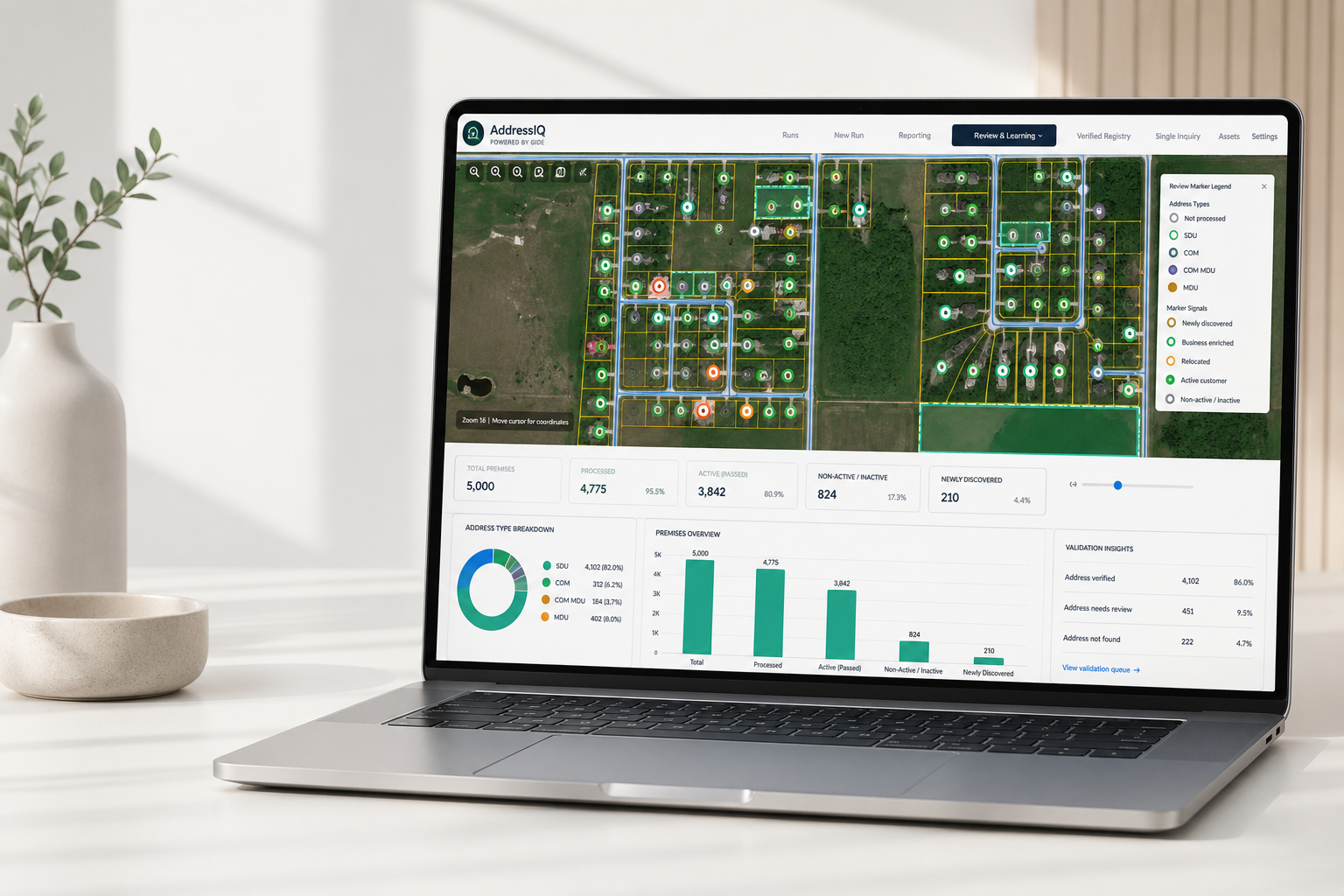
Validate premise counts, enrich the network address layer, and surface new in-footprint units before bad data distorts funding, build, sales, or audits.
AddressIQ turns premise counts, serviceability states, and network-adjacent opportunities into one governed record that planning, sales, field, and reporting teams can all trust.
Why investors care
AddressIQ exists because premise counts are not just an operations problem. They shape funding assumptions, build sequencing, revenue expectations, and the questions an auditor can ask later.
Funding and build assumptions
When grants, subsidies, and expansion plans are modeled on premise counts, the address layer becomes part of the investment case.
AddressIQ
AddressIQ resolves duplicate addresses, parent-child edge cases, unit inflation, and polygon conflicts before they distort the count.
FieldIQ loop
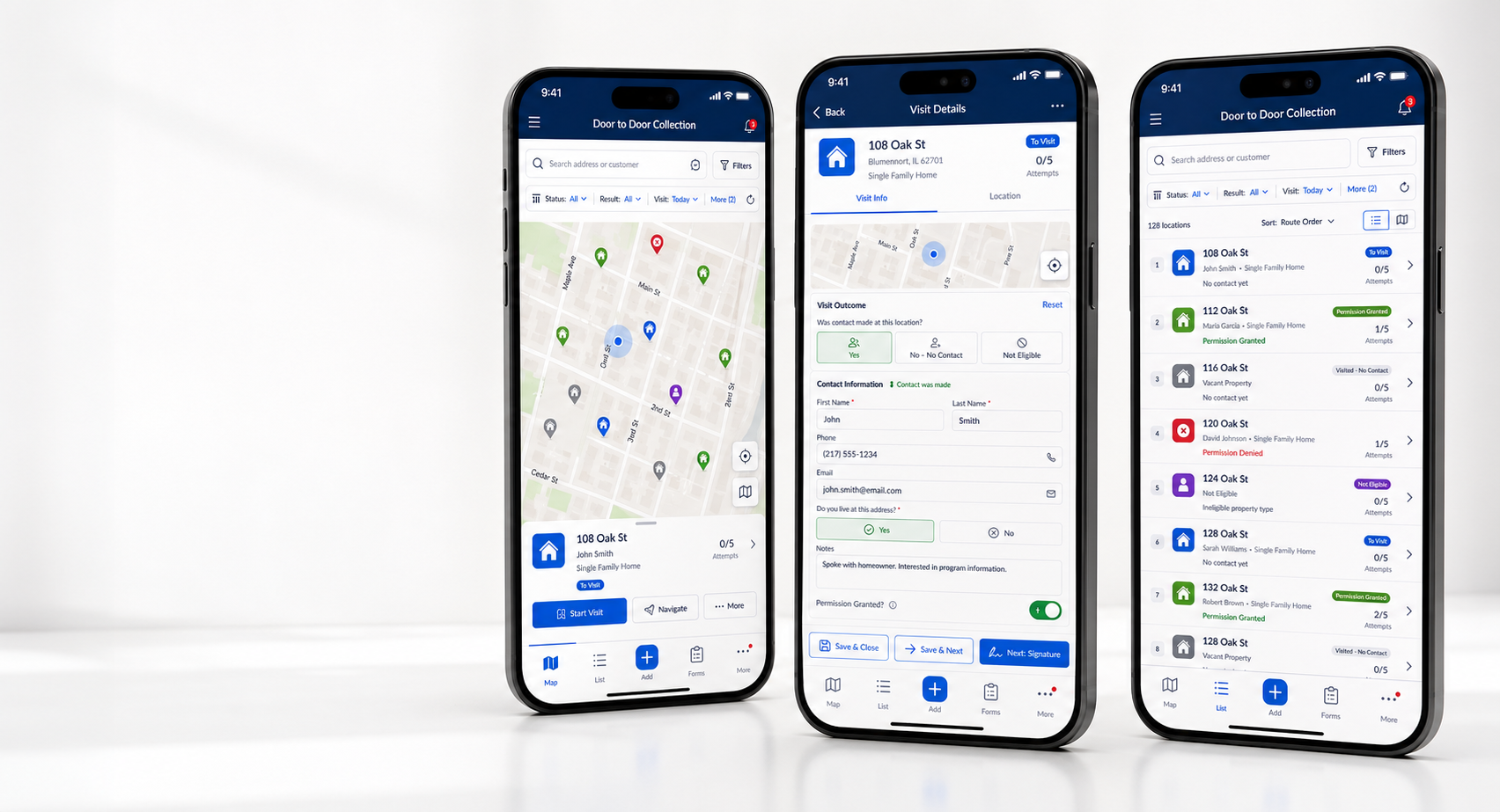
FieldIQ confirms premise truth on-site, captures evidence, and surfaces newly discovered units, developments, and corrections that desk data misses.
Governed output
The result is one governed answer for passed counts, active counts, newly discovered opportunities, and future audit response.
Government funding and build assumptions are often awarded on premise counts that drift over time.
Passed and active counts stop agreeing when units split, duplicates persist, or parent-child logic is weak.
New units and developments appear on-network without ever entering the planning and sales system cleanly.
When audits arrive, teams need lineage on why a count changed, not another spreadsheet reconciliation exercise.
Telecom impact
Premise counts, serviceability states, and exception handling stay governed enough to support internal review, external scrutiny, and future audit response.
The address layer stops hiding newly discovered units, adjacent developments, and corrected serviceable opportunities that should already be in the commercial motion.
Planning, field, sales, and reporting inherit the same governed premise answer instead of parallel counts, local fixes, and conflicting narratives.
Executive and investor value
Gives investors, ownership, and program leaders a cleaner read on whether the premise assumptions behind a funded or planned build still hold.
Surfaces newly discovered units, corrected addresses, and developments inside or adjacent to the network before they become missed sales opportunity.
Stops premise inflation, undercounting, and unresolved duplicates from quietly distorting planning, reporting, and execution over time.
Improves route, parcel, and serviceability confidence before crews move, designs are finalized, or customer commitments are made.
Creates traceable lineage for premise classifications and count changes so the explanation is already in the system when scrutiny arrives.
Publishes the governed answer back into CRM, planning, field, and reporting so teams stop inheriting stale or contradictory premise records.
Deliverables
Database effect
A premise is validated, corrected, or newly discovered on the network.
AddressIQ stores the governed record, the evidence, and the count impact in one system.
Planning, sales, field, and reporting inherit the same updated answer instead of working from drifted copies.
Every resolved premise strengthens the network dataset so the next funding, build, or audit decision starts from a better baseline.
AddressIQ is built for operators that need premise truth to hold up across funding, planning, field execution, sales, and reporting.
Most teams already have data. The problem is that the count, the address, and the network reality stop agreeing with each other when the decision matters.
One system may show a premise as passed.
Another may count it as active.
Field teams may know a subdivision, split, or missing unit that never makes it back into planning or CRM.
AddressIQ gives that problem a governed operating model instead of another cleanup exercise.
AddressIQ creates a canonical premise record, applies serviceability and territory logic, validates counts against the network, and publishes the resulting decision state into the systems that teams already use.
That includes:
The value is not abstract.
AddressIQ is best positioned as a productized service.
The implementation pattern is repeatable, but the exact business rules, source systems, and exception cases are specific to each environment.
The engagement usually includes:
AddressIQ does not just clean a record once. It feeds the premise database so every future lookup improves.
When a customer phones in with an address, parcel, or location, the system already has the normalized record and supporting context ready to use. That means faster identification, less back-and-forth, and a stronger foundation for every downstream team that relies on the same location data.
Fit check
Bring the source systems, the current premise-count logic, and the exception cases that consume the most time. We will map whether AddressIQ should be delivered as a standalone productized service or part of a broader operating stack.